Monday, October 8, 2012

Flashbulb memory

What is flashbulb memory?

Flashbulb memories are distinctly vivid, precise, concrete, long-lasting memories of a shocking events. People remember with clarity every detail, what were doing when it happened, with whom they were and where they were. The flashbulb memory is not as accurate or permanent as the photographic, but the flashbulb is less effected with time. The flashbulb memory are stored at one occasion and retained. This memories can be associated with big historical events or autobiographical events. The emotional arousal at the moment that the event was recorded makes the flashbulb memory special. It also increases the ability to recall details from the event.

Brown & Kulik (1977)


Their aim was to find out whether dramatic,  or personally significant events can cause "flashbulb" memory. The asked the participants about 5 major events like the assassination of President John F. Kennedy and their memories on them. What they were doing, where were they when they heard the news. They found out that the flashbulb memory is more likely for unexpected and personally relevant shocking events. The memories for those events were vivid, detailed and long lasting. They remembered what they were doing, where were they, whit whom they were, how they felt when they heard the news and how people around them reacted. Dramatic events can cause a physiological imprinting of a memory of the event. The strength of FBM is that it provides evidence to support anecdotal and personal experience. Data were collected trough questionnaires so you cannot verify them and the repetition of those events could make you remember more from those events.

Neisser & Harsch (1992)

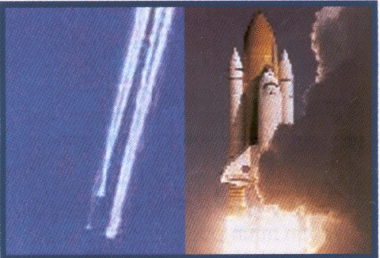
They studied the space shuttle disaster. They asked the participants one they after the disaster and 2.5 years later. The questions were : what were they doing, with whom they were, how did they found out etc. Participants reported highly vivid memories, but they were not accurate or didn't make any sense. The memories deteriorated significantly during the 2.5 years. The conclusion is that the FBM are no more reliable then normal memories. The results suggest that what is different is the confidence that people have in their memories associated with significant events.

Talarico & Rubin (2003)


Their aim was to find out the differences between TBM and normal  memories. They asked the participants to recall their memories on 9/11 and one ordinary event of their chose on different occasions 1, 7, 42 and 224 days after the event. In the later sessions they were asked the same questions about 9/11 and the ordinary event. The number of details were similar and sometimes even identical. Over the time their memories changed for both events. However, they believed more in the accuracy of the 9/11 memories. They stated that the rate of forgetting is the some, but people are more confident in their memories on the 9/11 even as the memories were forgotten. We can conclude that the rate of forgetting flashbulb memories is the same as for normal memories. This study also states that there is no difference in the memories, but in the confidence. The weakness of this theory is that they only tested retention intervals of eight month or less.

What are the important determinants of FBM?
Events that are shocking, surprising and often a national tragedy.

What role does emotion play in FBM?
Emotions play a big role in the FBM. So far it seems that amygdala that is responsible for emotions and triggers them faster than our conscious awareness. The shock that we go through when something consequential happens imprints into amygdala because of our emotional shock.  

PSTD Treatments

What is PTSD?

Post-traumatic stress disorder can happen to anyone. It is a result of  a traumatic experience. Most people with PTSD are soldiers that return home from war, but also people that helped during a catastrophe can result in having PTSD. The symptoms usually show up after 3 months. It differs with every person. Most common are nightmares, flashbacks, outburst of anger and avoiding the places associated with the event. PSTD was not and is still not threated as seriously as it should. Poeple with PTSD often result in "self-threatment" with drugs, alcohol and suicide.

Types od threatments?

Trauma-focused cognitive-behavioral therapy: In this therapy you expose yourself to the feelings, situations that remind you of the trauma. Thoughts that are irrational are then replaces to create "balance".


Family therapy: In this therapy you and your family try to unterstand each other better. PTSD also changes behaviour, relationships.


Medication: Medication is prescribed to some people with PTSD to reduce their symptoms such as depression and anexiety. Medication makes these symptoms more mild but it doesn't treat PTSD.


EMDR (Eye Movement Desensitization and Reprocessing): Eye movements and other bilateral forms of stimulation are thought to work by “unfreezing” the brain’s information processing system, which is interrupted in times of extreme stress.


Tuesday, September 18, 2012

Memory - how is it affected by gender and culture


Gender Differences

Men and women process things in different ways with different parts of their brains. it seems that testosterone and estrogen have different effects on how the brain cells turn out and how they function. There is also difference in neurons bethween men and women. This could explain why women have worse cases of dementia and Alzheimers. different perspectives and interests that those things which are the focus of a particular gender also impact how memory is used.

Psychologists Agneta Herlitz and Jenny Rehnman in Stockholm did a research about gender difference and effects on the memory. They found out that women have better episodic memory, a type of long-term memory based on personal experiences. Women also excelled in verbal episodic memory tasks. Men on the other hand were better at remembering symbolic, non-linguistic information, known as visuospatial processing. Women curenlty hold an advantage in episodic memory. 


Culture Differences

The culture that we grow up with determines our view on things. Western cultures tend to focus on objects and categories, ­whereas people from Eastern cultures tend to focus more on contextual details and similarities and sort by functional relationships. Our parents and our surrounding also plays a big role on our memory. The way family comunicates and talks to as, repeats certain events. The more is our memory focused on family events rather than on indivudual memories. The earliest memory a person can have can be 2,5years (tribes), 3years(USA) or 4years(Korea).

Sunday, September 16, 2012

Alzheimer's Disease: The Forgetting

1. Why do you think Alzheimer's disease is so much more common now than it was in the past?
Countries are more developed nowadays than they were before and have a large proportion of elderly people. Some researches show that Alzheimer's is more common for people who live in urban area's.

2. How is Alzheimer's an economic issue?
The high cost of health care for the patients and their inability to care for themselves effects family members who take care of them. The costs of nursing home and health care for the patients often exceeds the resources of the individuals.

3. Explain how Alzheimer's disease was "discovered".
 it was described before, but t was not until 1906 that a German physician, Dr. Alois Alzheimer, specifically identified a collection of brain cell abnormalities as a disease. One of his patients died after years of severe memory problems, confusion and difficulty understanding questions. he later on performed an autopsy. he doctor noted dense deposits surrounding the nerve cells. 

4. Explain the concept that Alzheimer's robs you of your identity.
People start to forget where did they put things and what were they supposed to do. They have trouble with their memories, the recognition of faces. Often they don't recognize family members. One second everything is perfectly normal and the next one they act mean and violent to the persons they were talking to before. As the time goes on it becomes more severe and the change in their behaviour happens often.

5. Describe the process that Alzheimer's disease follows.
The disease is divided into 4 stages :

Pre-dementia: Can be easily mistaken for aging or stress.
Early: Vocabulary is shrinking and word fluency decreased.
Moderate: Behavioural and neuropsychiatric changes become more prevalent.
Advanced: The person is completely dependent on caregivers, loss of speech.